Forum Replies Created
-
AuthorPosts
-
 RossKeymaster
Ross Mar 25, 2017
I don’t mention many specific positions unless there may be a specific issue someone is having to help them. My method is not about specific positions… we use Large Muscles in an athletic movement.If the elbows start towards each other, and facing back towards the hips … that’s how they should return (pretty much) during the swing, through impact. Now, if an individual gets his back elbow in a position of returning through impact pointing “to his right” (not in front of the back hip pointing at the hip), then I might say (so he knows the correct position and feeling)… feel the back elbow “lead” on the downswing, so it is leading his back forearm and returns in front of the back hip, pointing at the hip. Sorry, this is hard to explain.
RossKeymasterRoss Jun 04, 2014
Hi Bill
The ball is “pinched” when the shaft is in line with the front arm, leading the club face at impact. Now, with my method, this is much easier because we use the body rotation to move the arms around to the left (right hander). If you are hitting chunky… you are either starting with too much weight on the back foot, or are moving to the back foot, and then not getting back in time… and “flipping” or throwing the club head at the ball… it is releasing (not good). We want to keep the 60% weight on the front foot during the backswing and you will not chunk the ball (ever).Now, your thin shots are purely “flipping” for some reason. Many times it is because the back elbow gets stuck on the back hip as you are rotation (that flips the face)… that back elbow must lead on the downswing, back in front of the body and around to the left… THIS IS ALL DONE VIA THE BODY ROTATING. The body rotation brings the arms back down and around. This is harder to explain than do.
Ross
RossKeymasterRoss Apr 07, 2017
1. No thoughts.2. I have not experimented at all with a palm grip, so I don’t have an opinion. I would be careful of the palm grip… due the lie angle of your conventional club vs. his custom clubs, because you may dig the toe into the ground from a “too upright swing plane” as a result of the palm grip. Please watch “The Grip” lesson video for info on grip options that I’m familiar with.
RossKeymasterThank you so much for your dedication and testimonials. This is such an important part of a reliable golf swing.
RossKeymasterRoss Apr 11, 2017
I failed to mention, everyone has issues hitting into the wind. There is only so much you can do. A friend of mine use to hit off of the deck (no tee) and had good results. If you try this, that ball has to be right at the bottom of the swing arc or it won’t work.Also, you answered above and added a word I don’t use and I wanted to clarify, so others don’t think that came from me or my method … the word “low” Just keep turning and the body’s rotation brings the arms/club around to the left (right hander).
RossKeymasterRoss Apr 10, 2017
Hi Peter
My suspicion is that you have a “flip” just before impact that is adding loft to the shot. We want the angle of attack on the upswing/ascending into the ball, but if you have a driver with a lot of loft or a senior/lite flex, you will hit it higher than desired … especially if you add a bit of a “flip”. The photo below shows how your front wrist/shaft should look just before impact. Actually the shaft on this driver is a bit soft and it’s lagging, but you get the idea. Look at a video of your impact using driver and see if you can get a straight line with shaft and front arm. You may have the club head flipped. If you don’t, I’d move it back a bit in the stance or maybe consider less loft on a driver so your “effective loft” will be correct at impact to achieve what you’re after. You must be rotating, maintaining the correct shape through impact and around to the left, and not flipping, to get the “stinger” effect you’re after.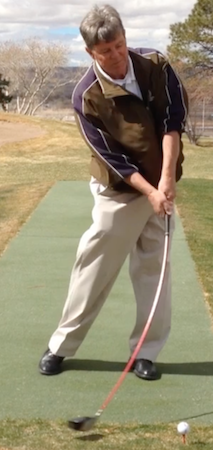 RossKeymaster
Ross May 01, 2017
I grab a SW (other clubs too) dozens of ways. All up and down the shaft and have taken shots holding only the metal shaft off the grip completely (rare but it was needed). Another thing I do is change my grip. I may use Vardon or Interlocking or 10 finger and like all of them. It really does not matter if you’re not flipping through impact. It really depends on the shot I see in my mind and how to get the job done. I love to choke down for control. The important part is that the SW leading edge must be “flat to gravity”*In general, I’d teach … having the pad of the front (left for right hander) behind the little finger “on top” of the shaft, but that is not in stone. That is old school and is a good starting point.
* Okay I made up another term, but it makes sense. If the ground was perfectly flat (no slope at all), the leading edge would be exactly flat, (no toe off the ground**), so the loft of the SW will move the ball exactly forward and square off the face 90° to the leading edge. This is CRITICAL especially around the green. Now, if you’re on a slope, you MUST adjust the leading edge to still be “flat to gravity”. This might mean adjusting the shaft angle up or down (holding the heel off the ground or the toe off the ground), so the ball will come off the face straight and roll end over end without side spin.
** Many sloppy golfers (or just don’t know), setup short clubs with the toe up off the ground. This makes the ball go left. Watch “Setup Sandwedge” at DUPLESSISGOLF in the Setup Section for more info.
RossKeymasterRoss May 19, 2017
You don’t use a club for this. The thumbs give you your shoulder line. If you move your front shoulder down, then up (correct for putting), you can see your path. This is the path the ball will roll if you have a square putter face. Now… if you move your shoulders around your spine*, you will change your path. This is why most right handed golfers miss left, because their front shoulder moves behind them on the downswing (changing the path) vs. pulling up with the front shoulder to not change the path.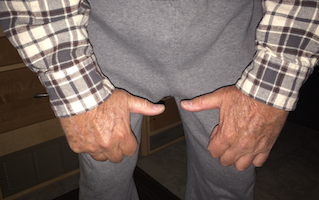
* We do not turn our shoulders around the spine for putting or chipping. We do turn the shoulders around the spine for all other golf shots. This is for more control when we don’t need much power.
RossKeymasterRoss May 15, 2017
Hi Ed
Sorry this got a bit long, but it is all great stuff that will work well once incorporated.#1
In a perfect world, the shoulder line and toe line would be parallel to the target line*. I know my feet are a bit closed, but that is okay because the path the putter head moves along, is exactly underneath the shoulders, and can be seen/practiced, by letting the arms hang**. What this means is, the shoulders dictate the path, not the feet. The path won’t change unless you let your hips or head move (a nono [nono]). The shoulders are the only thing that moves with my method. Have a friend watch you to point out how many other body parts move during your stroke. It takes a lot of work to not move anything except the shoulders.Now, the putter face is exactly 90° (perpendicular) to this target line, and hangs (about 1/2″ off the ground) above this line, exactly on the sweet spot … and your eyes*** must be over this line too. These all add up to many more makes.
#2
No, there should not be any contact with the body during the stroke.* The target line is the line you want the ball to start on that allows for break if needed. This may be a line straight thru the cup if no break is needed.
** Once setup, with the arms hanging, you can find your shoulder alignment, and the path the putter head will travel, by pointing your thumbs towards each other (Thanks to Dave Pelz)… then while pointing your thumbs towards each other, push down and pull up the front shoulder to see the path. It is easy to see if your path is in-to-out, or out-to-in, to your target line… we want straight back and straight thru along the target line. We don’t use the hands/arms to manipulate the path, the shoulders must do the work while the arms hang. Then, setup using your putter the same way. Just make sure the putter face is exactly 90° to the path your shoulders make. HINT: The grip end must be setup ahead of the ball a bit, and you must keep firm wrists during the entire stroke, to keep the putter head from flipping ever.
*** As you let your arms hang at setup, you want your eyes exactly over the target line too. Once setup, you can drop a golf ball from the bridge of your nose, and see where it hits on the ground, to see if your eyes are over the line. Most are surprised when they try this. You may need to allow for a bit more tilt, to get your eyes over the line to not brush your body during the stroke. If you add more tilt, this must still be athletic and in balance (no lean out or reach out).
RossKeymasterRoss May 20, 2017
First … you can do anything you want if it works for you.Second … since we do not use the hands/arms to help*, your maximum rotation speed is as fast as you can rotate. Also, if you have maximized the backswing, and then use your maximum downswing rotation speed, you’re maxed out. I also believe your max backswing/downswing can change slightly at different times (not warmed up, warmed up and excited, tired at the end of the round, weather conditions, extra/less clothing like jacket etc.)
* It is very important to understand, if your hands take over or help, your body stops. You don’t get both … your body won’t turn and hit at the same time. A person swing an axe into a tree, will not keep turning his body and hit the tree with his hands throwing the axe, at the same time, he’ll stop his rotation just before the hands take over to hit at the tree. The body stops to take on a “supporting role” so the hands have something to swing against to throw the head of the axe. This action (stop body, throw club head) in golf, makes for a very bad golf swing and it not reliable.
RossKeymasterRoss Apr 03, 2017
Thanks for the nice comments.Golf is about 2 things… direction and distance (that’s all). I would like to also mention, there are many aspects of golf, and the golf swing is only one part.
My method uses the entire body at impact, as a sum to move the ball. All of the body mass is being used*. I incorporate an athletic move to the golf swing, like throwing any object. We use the Large (more repeatable) Muscles to move the arms/club for more reliable impact, and that equates into more accuracy with both direction and distance. I’m not implying you’ll hit the longest 7 iron ever, but you’ll hit it straighter and about the same distance each time, due to a square face at impact and finding the sweet spot more often.
I guess what I’m trying to say is … the hands are only a small part and all they do is hold the club. If they “flip” the club head everything changes (path, face angle, shaft angle, loft, direction, etc.) and we know what happens next… golf can be more fun when almost** everything below the shoulders is maintained letting the big muscles do the work.
* More mass is more efficient at times … like pitching a ball out of deep rough. The body mass rotating, can pull the ball out much easier than a stationary body using the arms or hands (much weaker)
** The elbows need to bend a little (at different times) depending on the shot, but they do not move on their own.
RossKeymasterRoss Apr 02, 2017
My method was established about 15 years before S & T came out. As far as I know we have nothing in common since I’ve never looked into their method. We do keep at least 60% weight on the front foot for more consistency, and so we can rotate without the need for an unreliable weight shift to the front leg first (traditional golf).RossKeymasterRoss May 22, 2017
The Finish Drill is in the “Drills” section.RossKeymasterRoss May 21, 2017
You don’t really have to worry about tempo, because we swing at many different paces depending on the shot. It is good to have equal rhythm on the backswing and downswing. Slower is better for the longer clubs. Each person has to find his own paceThe Drills are the real key for learning this method. The Finish Drill, Stop Rotate Drill, Large Muscles Drill, are key and should be done daily or as a warmup. The Fixed Wrist Drill is a great warmup too.
RossKeymasterRoss May 26, 2017
1 No, I don’t think of the golf swing as a circle. Think of Large Muscles… Shoulders (backswing), then the body (core) unwinding from ground up (downswing).2. The upper arms both automatically do what they need to do when you start with the elbows pointing back at the hips and keep the elbows working towards each other.
The easiest way to learn this golf swing is to do the Drills regularly … not just for a week or two … just keep doing them. They’ll do the job vs. trying to think your way through. Time and Effort.
-
AuthorPosts